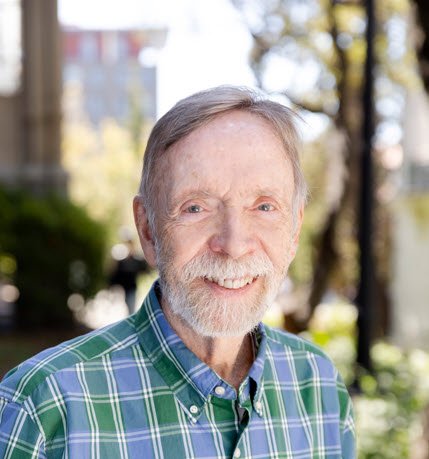
Frank Coyle (drC)
UC Berkeley faculty teaching Generative AI. Visiting Professor at the University of Bologna. Retired from Southern Methodist University after 32 years in computer science. Founder, The AI Edge.
Teaching
Frank teaches graduate courses on generative AI and large language models at UC Berkeley, where Master’s level students in the Data Science and Information Systems programs apply foundational AI concepts to working systems through hands-on project work.
Earlier, Frank spent 32 years on the computer science faculty at Southern Methodist University, where he received several Best Teacher Awards in the CS department and where students call him drC. His SMU teaching spanned the full CS curriculum, from introductory programming through advanced topics in software engineering, AI, and systems. During his tenure at SMU, he also served as Program Director for the Online Program in CS/Artificial Intelligence.
Frank also serves as Visiting Professor at the University of Bologna, one of the oldest universities in the world, where he teaches in the Executive Masters Degree Program in Business and Artificial Intelligence — giving executives the practical tools they need to understand the economic, organizational, and ethical implications of AI and translate them into actionable next steps.
Academic background
Frank's academic path is unconventional and informs how he thinks about AI. Bachelor of Science in psychology from Fordham University. Master of Science in physiological psychology from Emory University, where he dissected brains alongside medical students, ran ablation experiments on the visual systems of rats, and implanted electrodes into the brains of cats to study neurophysiological pathways.
He went on to a Master of Science in computer science from Georgia Tech, then a PhD from Southern Methodist University.
The detour through neuroscience shapes how Frank teaches AI. Modern neural networks borrow loosely from cortical architecture, but the path to general intelligence likely involves more than scaling cortical models — it may require understanding how subcortical structures, like the thalamus and the reticular formation, integrate sensory and motor information to produce the modes and states that higher cortical centers organize cognition around.
Teaching philosophy
A line from Sister Corita Kent's Ten Rules for Students and Teachers — later popularized by the composer John Cage — captures the teaching philosophy behind The AI Edge:
"Nothing is a mistake. There's no win and no fail. There’s only make."
The approach is called MAKE. You don't learn AI by reading about it, watching demos, or memorizing concepts. You learn it by making things. Some will work. Some won't. Both teach you something.
This shows up in how every course is designed. Lectures are short and exist to set up the build. Each week culminates in a working artifact — an agent, a tool, an MCP server, a prompt library — that students push to GitHub. By the end of any course, students have evidence: a portfolio that shows what they can actually do, not what they've watched.
The same approach has shaped thirty-plus years of teaching. Concepts get clear when students apply them. Frustration is part of the process, not a sign something's wrong. The goal isn't to avoid mistakes — it's to make enough things that the mistakes stop mattering.
Get in touch
The AI Edge is preparing for its first cohort of Build to Certify in June 2026. If you have questions about the course, partnership opportunities, or how to apply foundational AI concepts in your organization, reach out.
Email: drc@codesupreme.ai
LinkedIn: linkedin.com/in/frank-coyle
Discuss Your Learning Objectives With Our Team
Submit the inquiry form to initiate a detailed conversation regarding customized learning strategies that align precisely with your institutional goals.